
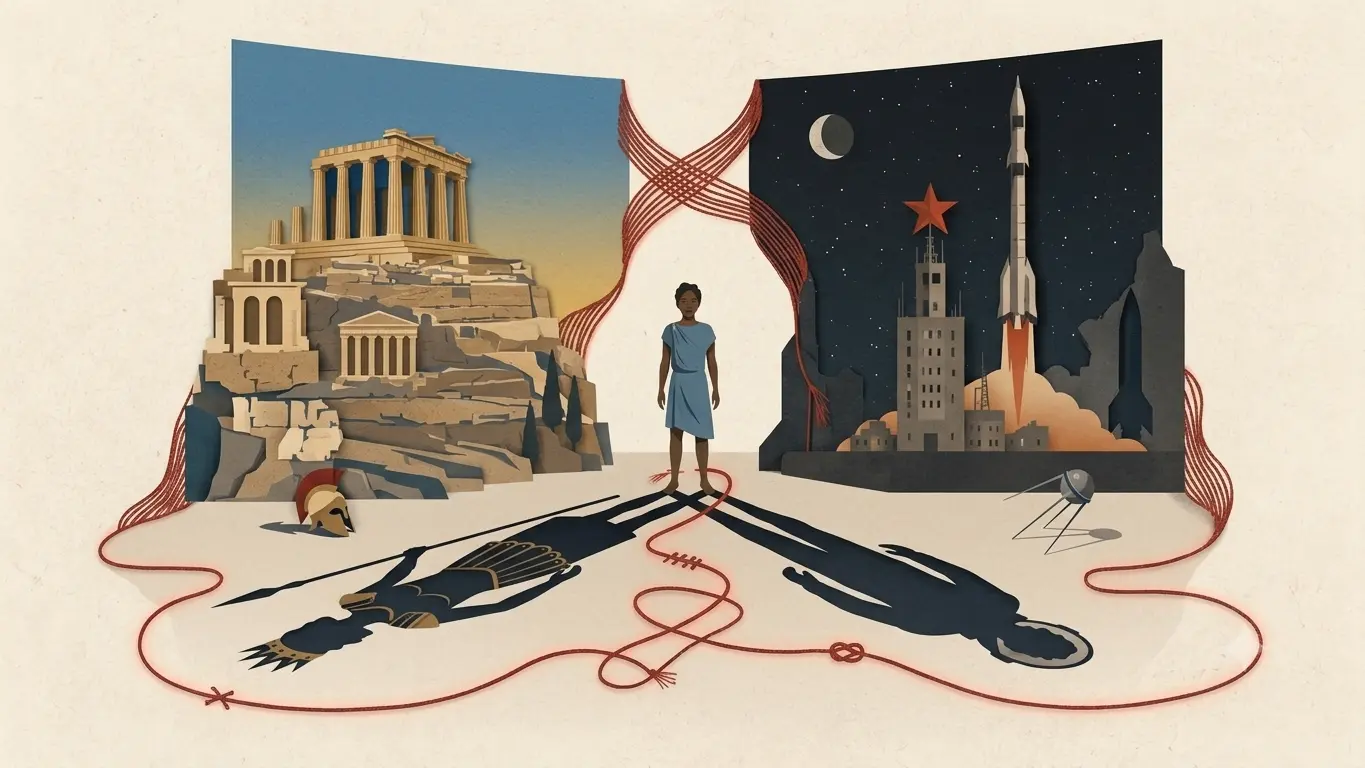
Why Does Everyone Suddenly Care About This?
A Gen X take on accents, Helen of Troy, and the mermaid nobody actually had a problem with
I've spent my whole life asking myself what I am.
Not because any one person sat me down and demanded an answer — but because of how people around me interacted with me, in small ways, over and over, until the question stopped coming from outside and started living inside my own head instead. Light brown skin, mixed features, enough of both worlds visible on my face that people on both sides felt entitled to sort me before I'd said a word — the comments, the double-takes, being sized up in a beat too long. That's real, and I'm not pretending otherwise. What stayed with me, though, is that the audit kept running long after the people who triggered it had moved on. My father's father came to the Netherlands from the Moluccas in 1951, part of the wave of KNIL soldiers and their families who were told it was temporary and then simply never went home. My mother is Dutch. Which makes me, depending on the day and my own mood, half of something, or fully Dutch with an asterisk, or "not really" either, or both at once in a way that never quite adds up to a whole number.
I grew up feeling too Dutch in one set of rooms and too brown in another, and the strange part is that the discomfort was mostly mine — I built an identity out of leftover pieces and then spent decades quietly auditing it myself, running the same math over and over, without ever landing on an answer I fully believed.
So when people ask why I have opinions on race-swapped casting that don't sort neatly into either camp — outraged purist on one side, "representation above all" on the other — that's why. I've never gotten to have an uncomplicated relationship with the question "does this person belong to that category or not," because I've been asking it about myself for as long as I can remember. So I notice, more than most people maybe, when a story is asking a real question about who belongs where, and when it's asking a fake one.
That's the lens for everything below. Not "Gen X doesn't care about race" — that's too clean, and I don't think it's even true. It's closer to: my generation didn't get handed a script for how to feel about it, and I especially never did, because I was never handed a script for what I was, either. So I default to asking the specific question in front of me, every time, instead of running everything through the same argument.
Star City and the Vanishing Accent
Start with the easy one, because it isn't even about race — it's about basic craft.
Quick context if you haven't seen it: For All Mankind is the Apple TV alt-history series where the Soviets beat America to the moon, and the whole show runs on the tension of a Cold War space race that never cooled off. Star City is this year's spinoff, telling the same story from the Soviet side — the cosmonauts, the engineers, the KGB minders, all of it set in the actual Star City training complex outside Moscow.
Here's the problem: the spinoff cast British actors to play those Soviet cosmonauts and then had them speak in their own native accents, unaltered, while the camera lingers on Cyrillic newspapers they're apparently reading fluently. The parent show didn't do this. For All Mankind cast actual Russian actors, let them speak with real Russian inflection, used subtitles when the moment called for it. It respected the audience enough to let the illusion hold.
Star City didn't. The showrunners have said, essentially, that a fake Russian accent gets old after ten minutes, so they skipped it entirely. Fine — that's a legitimate production problem to wrestle with. But the fix they landed on wasn't a solution, it was a shrug. It's not a bold artistic choice. It's the sound of a decision getting made in a budget meeting rather than a writers' room, and it took me out of the show every single time a "Muscovite" opened his mouth and Yorkshire came out.
Nobody's oppressed by this. Nobody's making a political statement by noticing it. It's just bad continuity, and it's fair game to say so. I'm mentioning it first precisely because it has nothing to do with the rest of this piece — it's a useful control group. Sometimes a casting or production choice is just sloppy, full stop, with no identity question attached at all.
Helen of Troy and the Confusion Between Two Different Arguments
Here's where it gets more interesting, because two separate claims keep getting mashed into one online, and neither side seems to want to untangle them.
For anyone who missed it: Christopher Nolan is adapting Homer's The Odyssey — Matt Damon as Odysseus, the whole ten-year journey home after the fall of Troy — and cast Lupita Nyong'o as Helen of Troy, the queen whose abduction (or elopement, depending on the telling) started the war in the first place. It's the character behind "the face that launched a thousand ships," and Homer describes her repeatedly as fair-skinned and golden-haired. The casting kicked off a real fight online, Elon Musk weighed in, Whoopi Goldberg fired back — the works.
Claim one: Helen of Troy wasn't a real historical figure, so nothing about her casting is "historically inaccurate," because there's no history to be accurate to.
Claim two: whatever population Helen is written as belonging to — a Spartan queen in a Bronze Age Aegean setting — has a documented demographic reality, and it doesn't include African ancestry.
The first claim is a dodge dressed up as an argument. Sure, Helen might not have existed. But Achilles didn't exist either, and nobody thinks a movie could cast him as a seventy-year-old woman and call the complaints unreasonable because "he's fictional." Fictional characters are still written as something, embedded in a world with real contours, and those contours matter to why the story reads the way it does — a face that supposedly launched a thousand ships is doing specific cultural work tied to a specific ideal of beauty in a specific place and time. You don't have to believe in the literal woman to think the casting should still gesture at the world Homer built her inside.
That's not "insulting the author," as some of the loudest voices put it — I think that's overstating it. But it's also not nothing, and "well, technically she's a myth" doesn't actually answer the objection. It just changes the subject.
Maybe this is the one where my own math creeps in. I know what it's like to be told you're not quite the thing you're standing in for — Dutch enough for the Moluccan side to raise an eyebrow, Moluccan enough for the Dutch side to do the same. Belonging to a specific world, with specific written-in contours, was never something I got to take for granted. So I don't think it's cruel or reactionary to say a character written into a specific world should still gesture at that world. I think it's actually the same instinct that made me spend thirty years trying to work out my own percentages — the details of where someone's from aren't decoration, they're structural.
The Ariel Thing I'm Including Even Though I Don't Fully Believe It
I'll be honest about this one because consistency matters: Ariel doesn't really belong on this list.
This one goes back a few years now, to Disney's live-action The Little Mermaid remake, which cast Halle Bailey — a Black actress and singer — as Ariel, a character who'd been drawn as red-haired and pale-skinned in the animated original since 1989. It became one of the first big flashpoints in this whole "race-swap" conversation, complete with the fake "boycott" campaigns and viral videos of toddlers meeting a Black Ariel for the first time.
Mermaids aren't a documented historical population with an ethnic makeup that can be gotten "wrong." There is no Bronze Age Aegean sailing document establishing that mermaids are pale. It's a fantasy creature adapted from folklore that already varies by coastline and culture, and "why wouldn't a mermaid be Black" is a completely fair question that I don't have a good comeback to.
I'm including it here anyway, because it's part of the same cultural moment and pretending otherwise would be dishonest — but it's the weakest entry in this whole genre of complaint, and I think a lot of people who lumped it in with everything else were just pattern-matching to outrage rather than thinking about what actually made Helen or Star City different in kind. If anything, this is the one where growing up mixed makes me less sympathetic to the outrage, not more — I've never had the luxury of believing identity has one correct, fixed answer. A mermaid can just be whatever the story needs her to be. Some of us don't get that freedom about our own faces; a fictional half-fish woman certainly can have it.
Wicked, and Why It Never Bothered Me Once
And then there's Ariana Grande as Glinda, which — for whatever it's worth — never registered as a controversy in my head at all, and I think the reason is instructive.
Wicked is the Wizard of Oz prequel — first a novel, then the long-running Broadway musical, now the two-part film — about Elphaba and Glinda's friendship before one of them turns green and famous and the other becomes a Good Witch. Grande took over the role Kristin Chenoweth originated on stage, and by nearly every account nailed both the comic timing and the vocals. Nobody I've seen raised an eyebrow at the casting itself.
Wicked isn't set anywhere real. It's not adapting a historical figure, a documented population, or a text making claims about a specific place and time. It's a stage-musical universe built from the ground up as invented mythology, the same category Bridgerton lives in with its alternate Regency London — a world explicitly built to not be the real one. Casting there isn't correcting or overriding a known backdrop, because there's no backdrop being overridden. It's just... casting. You pick the best person for the role, full stop, and Grande was clearly that. Nobody had to squint and pretend a documented world didn't exist to enjoy it.
That's the actual dividing line, as far as I can tell, and it's not race. It's whether the fiction is asking you to hold two incompatible pictures of the same specific place in your head at once. I know that feeling better than most people do — I've held two incompatible pictures of the same specific person in my head my entire life, and that person was me. I don't wish that particular tension on any fictional universe that doesn't need it.
The Gen X Thing, and the Thing Underneath It
I've seen people chalk this whole reaction up to generational politics, and I'll own my part of that framing, because there's something to it — my generation didn't grow up with a vocabulary for treating every piece of casting news as a moral event. A movie worked or it didn't. An actor was right for the part or they weren't. Nobody handed you talking points before the trailer dropped.
But I don't think that's the whole story, at least not for me. I think the real reason I default to asking the specific question in front of me — does this choice serve this story, in this world — instead of running everything through one blanket argument, is that I never let myself run my own identity through a blanket argument either. I never got to just decide "I'm Dutch" or "I'm Moluccan" and have that settle it, because I was the one who kept reopening the question. Every single time, I had to look at the actual specifics: which room I was in, what the moment actually required, which half of me the situation was even asking about. You learn, eventually, that "which category do you belong to" is rarely a yes-or-no question. It's a "compared to what, and in which context" question. That's not a coping mechanism I picked up from being online. It's just how I've had to think, because I never stopped interrogating myself about it.
So maybe that's the real dividing line I keep landing on, more than Gen X versus whatever comes after us: some people want one rule that settles every casting argument at once, in either direction. I've never once in my life gotten to have one rule settle anything about who I am. I'd rather just ask the boring, specific question every time: does this choice serve the specific story being told, in the specific world it built? Sometimes the answer is yes. Sometimes it's a shrug from a budget meeting. Either way, you're allowed to say which — and you're allowed to say it without pretending the answer is the same for every story, every time. Nothing about identity has ever worked that way for me. I don't see why it should for Helen of Troy either.