
In Star Trek: The Motion Picture (1979) an enormous cloud heads for Earth. The starship Enterprise is the only ship in range, with William Shatner as Captain Kirk. At its heart sits a machine that calls itself V'Ger. It turns out to be Voyager 6, an old probe of NASA, the American space agency, coming home to report.
The real one is called Voyager 1. It is still going. At 11:16 this morning, Dutch time, it was one light-day from Earth. Nothing we have built is further out.
How far that is
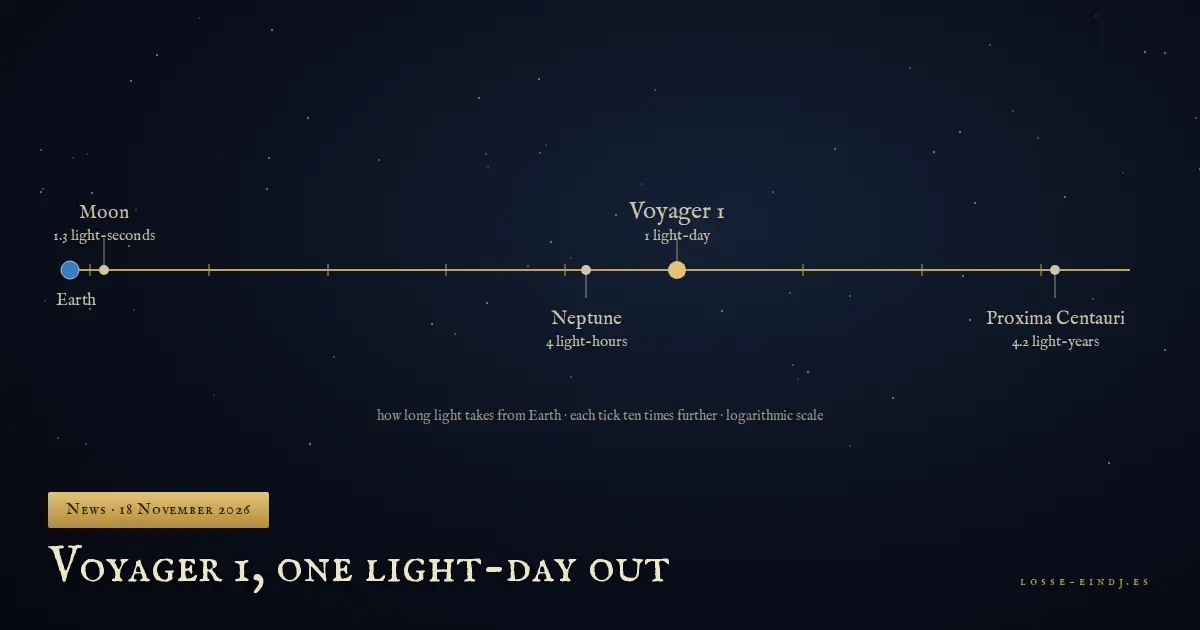
A light-day is the distance light covers in 24 hours, which NASA puts at 25.902 billion km. At 5:16:07 am US Eastern, which is 11:16:07 in Eindhoven, Voyager 1 was that far from us. Measured from Earth, where the antennas are.
The Moon is 1.3 light-seconds away. Neptune, the outermost planet, is about four light-hours out. A light-year is roughly 365 light-days, and the nearest star, Proxima Centauri, is about 4.2 light-years off. Voyager 1 has been flying for a little over 49 years.
Voyager 1 itself does about 17 km a second. Light does almost 300,000. Why nothing can go faster than light is in the speed limit, one of my Observatory rooms. Where both Voyagers are right now, to the kilometre, and which dish is listening to them this minute, is in the Voyager room next door.
The probe
NASA launched Voyager 1 in September 1977. It was built and is run by JPL, NASA's Jet Propulsion Laboratory in Pasadena, California. It flew past Jupiter in 1979 and Saturn in 1980. In 1990, from beyond Neptune's orbit, it turned its camera back. The photo is known as the Pale Blue Dot: Earth as a speck smaller than one pixel, caught in a beam of sunlight. In 2012 it left the bubble the Sun blows around itself and became the first human-made object in interstellar space.
Suzanne Dodd, Voyager's project manager at JPL, explains how a conversation goes: "If you want to say 'hello' to Voyager, you send your message and then you go home and you wait two days before you finally get a response."
Last night, after sunset, NASA asked people to "Shine Bright for Voyager's Light-Day": flash a message towards the spacecraft with a phone or a torch, even with whole buildings. If you did, it gets there this evening.
Both Voyagers carry a message of their own, a gold-plated copper record with sounds and music of Earth. "Johnny B. Goode", Chuck Berry's rock and roll song, is on it. Somebody chose rock and roll as a greeting to whoever is out there, which I respect.
And Voyager 2?
Voyager 2 is not there. It was launched sixteen days earlier, in August 1977, but took the slower road past Uranus and Neptune and is still the closer of the two. NASA expects its light-day in November 2035. It can wait.
— TimoNov 18, 2026