
Most people know the Big Bang from television first: a handful of scientists in Pasadena, a comic-book store, a couch with one seat that is taken. Ask them what the Big Bang itself looked like and you get a bang, a fireball, and everything flying outwards from one point like shrapnel from a grenade.
That picture is wrong. And the way it is wrong is more interesting than the picture.
The theme song, oddly enough, gets it right. Our whole universe was in a hot, dense state, then nearly fourteen billion years ago expansion started. Expansion, not explosion. Sheldon would insist on the difference, and for once he would be right to.
I carried that grenade around for most of my life. A dot, a flash, galaxies flung outwards, and somewhere, presumably, the spot where it all went off. Nobody ever asked me where that spot was, which is lucky, because there isn't one.
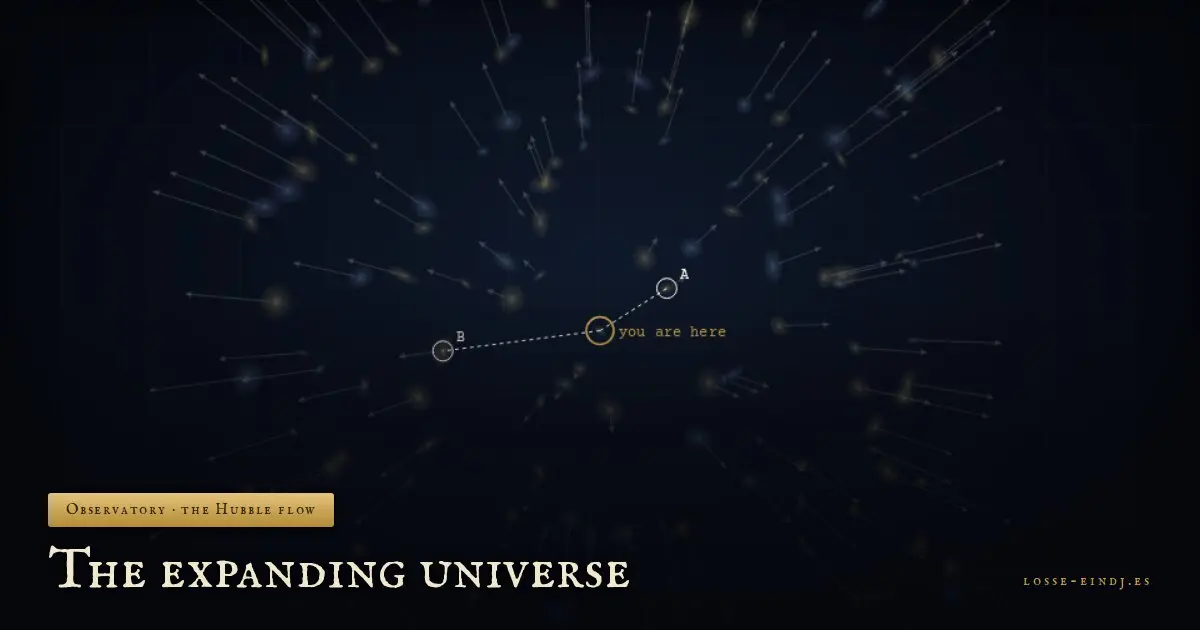
So I built a room for it in the Observatory on this site: the expanding universe, the first room of a new wing. Everything below happens live on that page.
The grid that stretches
Picture galaxies fixed to a grid, and the grid itself stretching. The galaxies do not travel through it. Each one stays at its own spot. Only the space between them grows.
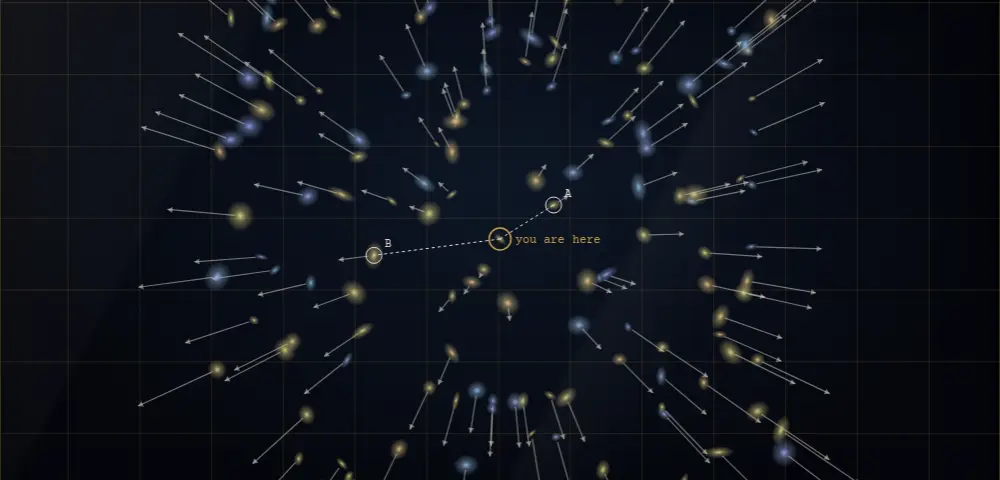
Now pick any galaxy and look at the others. They all recede, and the further away one is, the faster it goes. A galaxy twice as far has twice as much growing space between it and you, so it recedes twice as fast. On the page the arrows grow in proportion to the distance.
Click another galaxy and the picture is the same from there. Every galaxy sees all the others fly away from it, in every direction, in proportion. That is why there is no centre. There is no edge and no outside either, only distances getting bigger.
The first time I clicked a galaxy out near the edge of the field, I half expected the arrows to swing round and point back at the old middle. They did not. They never do. That is the whole lesson in one click, and it worked on me before it worked on anyone else.
Things that hold together do not stretch. Gravity binds a galaxy far more strongly than the expansion pulls it apart. Andromeda is even coming towards us, at about 110 km/s, and will merge with the Milky Way in some four to five billion years. Hubble's law is about the large scale, where galaxies are too far apart to hold each other back. You do not expand. Neither does the Earth's orbit, or the Milky Way.
Hubble's law, and a slope seven times too steep
In 1929 Edwin Hubble put the distances of a couple of dozen galaxies next to the redshifts of their light. Out came a rule: v = H₀ × d. Today H₀ is about 70 km/s for every megaparsec, and a megaparsec is 3.26 million light years. A galaxy 100 megaparsecs away recedes at about 7,000 km/s. One twice as far, twice as fast.
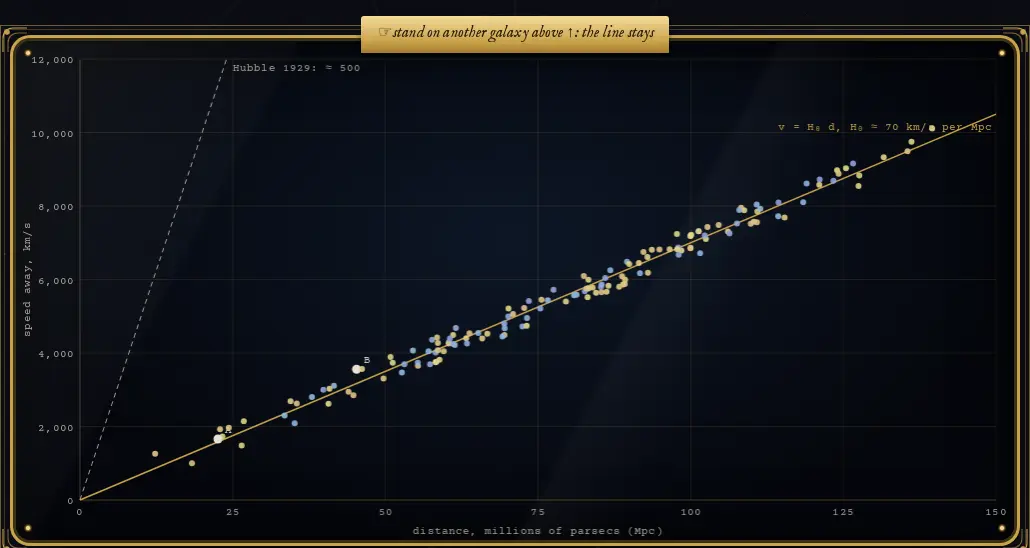
Plot the galaxies and they fall on a straight line through zero. Stand on another galaxy and you get the same line, with the same slope. The points do not sit exactly on it, because every galaxy also moves a few hundred km/s on its own, nudged by its neighbours. Up close that own motion wins, which is how Andromeda gets away with coming the other way.
Hubble's own line was about seven times too steep. He measured about 500 km/s per megaparsec. His speeds were fine; his distances were too small, and that mattered more than it sounds. Run his number backwards and the universe comes out at about 2 billion years old, younger than the oldest rocks geologists were already dating. Something had to give, and for once it was not the rocks.
The distances rested on Cepheids, pulsating stars whose rhythm gives away how bright they really are. Henrietta Leavitt found that rule in 1912. Later it turned out there are two kinds of Cepheid, and when Walter Baade corrected for that in 1952, the universe doubled in size at a stroke. The slope came down step by step to the 67 to 73 we argue about today.
It was not Hubble's law alone, either. Georges Lemaître derived the same relation from Einstein's equations in 1927, two years before Hubble, in a Belgian journal that hardly anyone outside Belgium read. In 2018 the International Astronomical Union recommended calling it the Hubble–Lemaître law. Fair enough, if a little late.
What "13 billion light years away" means
Now the light, because this is where the headlines get sloppy.
When the news says a galaxy is 13 billion light years away, it nearly always means its light has been travelling for 13 billion years. The galaxy itself is now some 30 billion light years from us. When that light left, it was only a few billion light years away.
So "how far away" has at least three answers, and they are all correct. Take a galaxy at redshift 1. Its light has been on its way for about 8 billion years. When it left, the galaxy was about 5.5 billion light years from us. Today it is about 11 billion, and it is receding at three quarters of the speed of light. One galaxy, three distances, no contradiction.
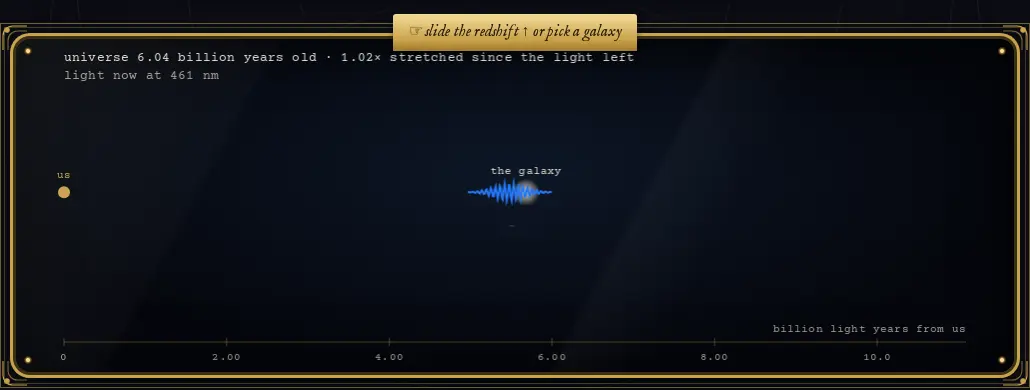
The redshift itself is read off the dark lines in a galaxy's light, with a spectroscope; there is a room for that too. It is not a Doppler shift, although up close it looks like one. While the light crosses space, that space stretches, and the light's waves stretch with it. 1 + z is how many times larger the universe is now than when the light left. Light from redshift 1 left when everything was half as far apart.
Push further and intuition gives up. The afterglow of the Big Bang, at redshift about 1,100, left when the universe was a thousandth of its present size. It set out as the orange-white glow of a gas at about 3,000 degrees, and it arrives as microwaves.
Past about 14.5 billion light years, galaxies recede faster than light. That sounds like a broken rule. It is not: nothing moves through space faster than light, but the space between two galaxies can grow faster, and it does. The speed limit room has the fine print.
And the strangest case of all: light that, at first, got further away from us. Light that left from beyond redshift 1.6 was swept back by the stretching and lost ground for a while, before it could start to gain on us. Its galaxy has been receding ever since.
Have a look
On the page, click any galaxy and stand on it. The arrows, the diagram and the numbers change to what you would see from there, and every time the answer is the same: everything is moving away from you, and you are not special. Lower down, a slider takes you back along the light. For the strange case, pick GN-z11 and watch the faint line.
Every number on the page is in its footnote, with where it comes from. If something looks wrong to you, tell me; I would rather fix it than defend it.
Part of the Observatory, a museum of live instruments on this site. Walk in: the floor plan →
— TimoNov 11, 2026