
 Seeing the Code
Most of us grow up believing the universe is made of solid things. Tables feel heavy, light feels instant, gravity feels like an invisible pull toward the ground. Our senses reinforce the idea that reality is built from objects moving through empty space, and for a long time science agreed.
When Isaac Newton described motion and gravity, the universe looked like a giant clockwork machine — predictable, mechanical, and governed by clear rules. If you knew where everything was and how fast it moved, you could, in principle, predict the future.
That worldview was extraordinarily successful. It built bridges, powered engines, and guided ships across oceans. Even today, much of engineering still relies on Newton’s insights because they work beautifully at human scales. But beneath that success lay a deeper question: what if the solid world we experience is only the surface layer of something far more dynamic?
As physics progressed, reality began to look less like machinery and more like structure — patterns emerging from deeper processes. And strangely enough, a scene from The Matrix offers a surprisingly useful way to imagine what scientists discovered.
The Clockwork Universe
In the classical picture, reality was straightforward. Objects had positions. Forces pushed and pulled. Space was a fixed stage. Time flowed the same everywhere. It was comforting because it felt intuitive. A thrown ball followed a clear path. Planets orbited in predictable ellipses. Cause and effect felt absolute.
Then Albert Einstein arrived and reshaped that certainty. Instead of treating gravity as an invisible force, he described it as the bending of spacetime itself. Massive objects curved the geometry around them, and motion followed those curves. Suddenly, space and time were no longer passive backgrounds — they were active participants in the universe. Einstein’s work hinted that the “stage” of reality might be as dynamic as the actors upon it. But even that insight turned out to be only one layer deeper.
When Reality Started Acting Like a Glitch
At the beginning of the twentieth century, scientists began probing atoms and light, expecting classical physics to continue working. Instead, the universe behaved in ways that felt almost like glitches in a familiar system. Particles acted like waves. Energy appeared in discrete packets. Measuring a system seemed to influence its outcome. Physicists like Einstein, Niels Bohr, and Werner Heisenberg realized that certainty itself might be an illusion at small scales.
Later, Richard Feynman and others helped develop quantum field theory, a framework that described reality not as tiny objects but as excitations in invisible fields. In this view, particles were not little marbles traveling through space. They were disturbances — ripples — in a deeper medium. That shift changed everything. Instead of imagining reality as a collection of objects, physicists began to see it as a layered structure of interactions and patterns.
The Hidden Fields Beneath Everything
Modern physics describes the universe as filled with fields: electromagnetic fields, electron fields, quark fields, and many others. Even empty space is not truly empty — it is a background of potential activity. When a field vibrates in a stable way, we observe a particle. A photon is a ripple in the electromagnetic field. An electron is a ripple in the electron field. Matter itself becomes a choreography of patterns moving through invisible structures.
This is difficult to visualize using everyday intuition because our senses evolved to perceive stable objects, not fluctuating fields. But once you adopt the field perspective, the universe begins to resemble a flowing system rather than a static collection of pieces. This is where The Matrix provides a surprisingly helpful metaphor.
The Matrix Screensaver
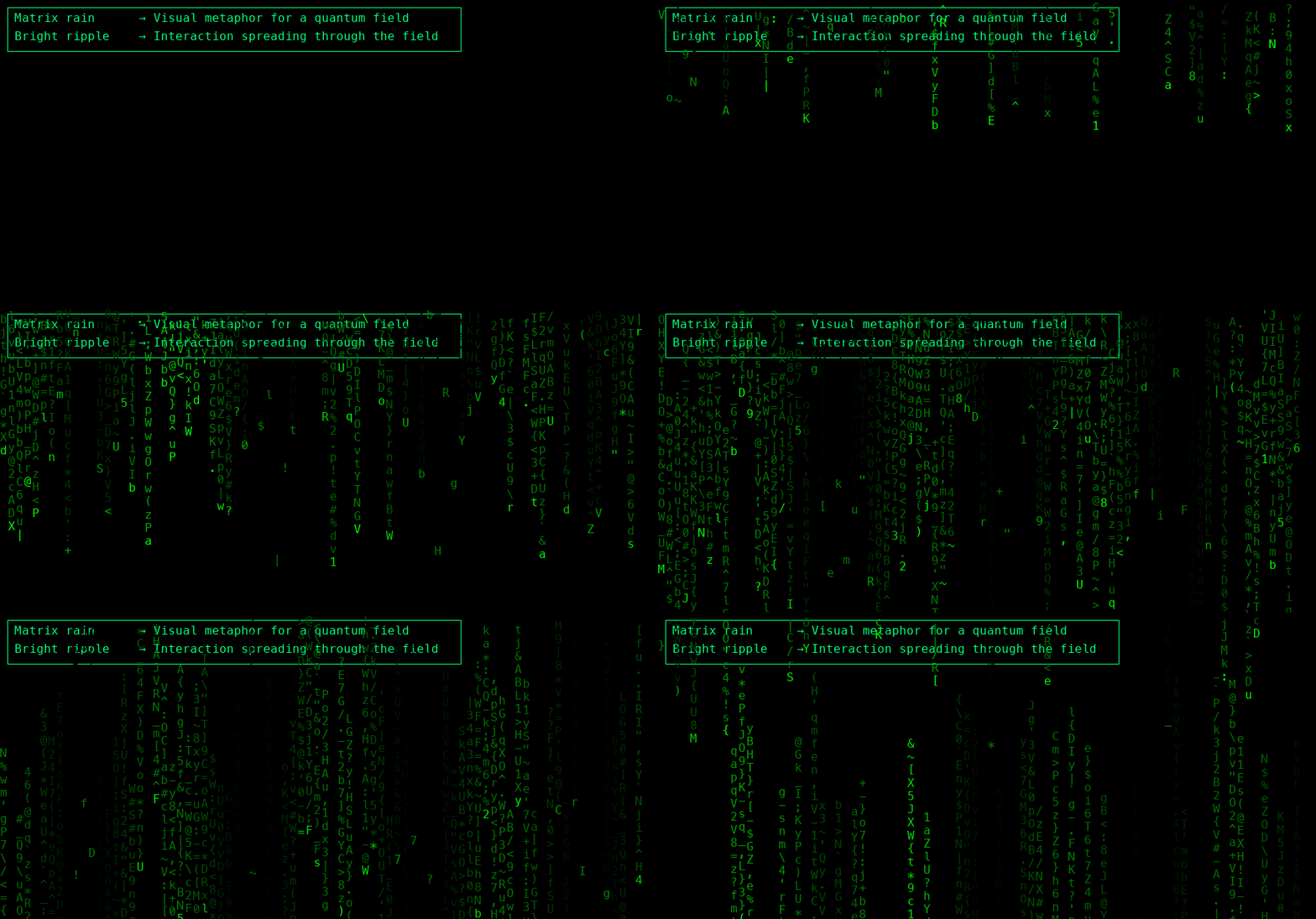
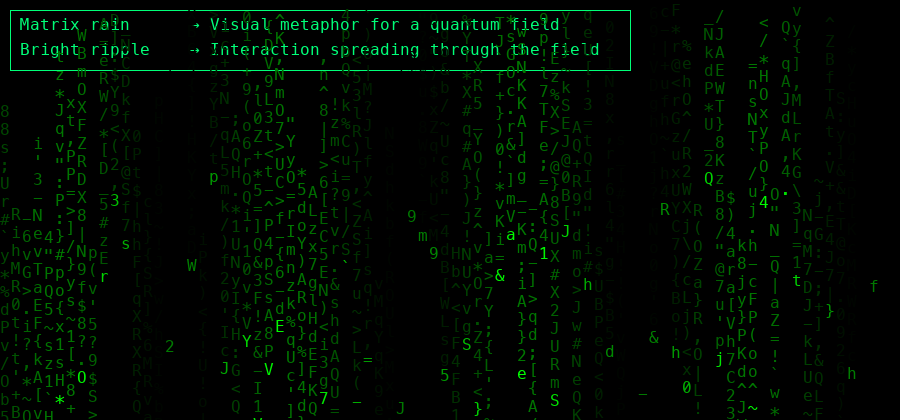
Think of the iconic green code cascading down the screen. In the movie, that code represents the hidden structure beneath the simulated world. In physics, we can imagine something similar — not literal code, but a continuous background of fields underlying everything we see.
Most of the time we experience only the interface: chairs, planets, beams of light. But beneath that interface lies a constant flow of activity. Particles become recognizable disturbances in that flow. Objects become stable arrangements of those disturbances. Motion becomes the evolution of patterns rather than the movement of solid pieces. The metaphor is not meant to imply that reality is a computer program. Instead, it offers a visual way to imagine how modern physics describes the world: as dynamic structure rather than static substance. In this view, what appears solid is actually a stable configuration within a deeper layer of motion.
The Hidden Setting: The Higgs Field
One of the most remarkable ideas in modern physics emerged from the work of Peter Higgs and others. They proposed that space itself contains a background field — the Higgs field — that influences how particles move. Some particles interact strongly with it and appear heavy. Others interact weakly and remain nearly massless. You can think of the Higgs field as a kind of hidden system setting. It does not push particles like a force. Instead, it changes how easily patterns move through the underlying structure.
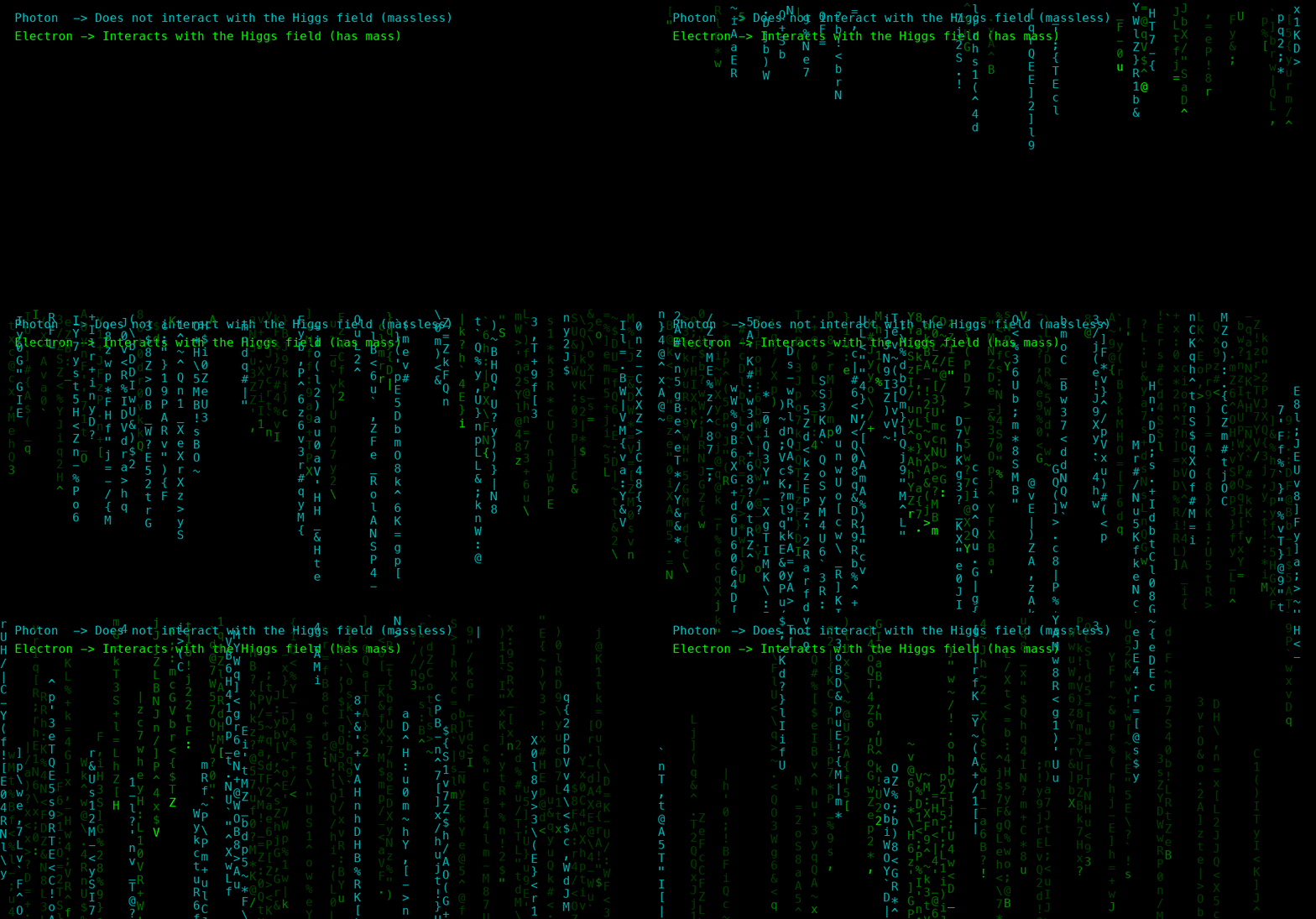
When scientists detected the Higgs boson at CERN in 2012, they were not discovering the origin of mass itself, but evidence of this pervasive background layer. In the Matrix metaphor, it is as if certain patterns move through thicker regions of the code while others glide freely.
Black Holes and Scrambled Information
If quantum fields reveal a hidden layer beneath matter, black holes reveal how strange that layer can become. Stephen Hawking showed that black holes emit radiation and slowly evaporate, raising a profound question: does information truly disappear?
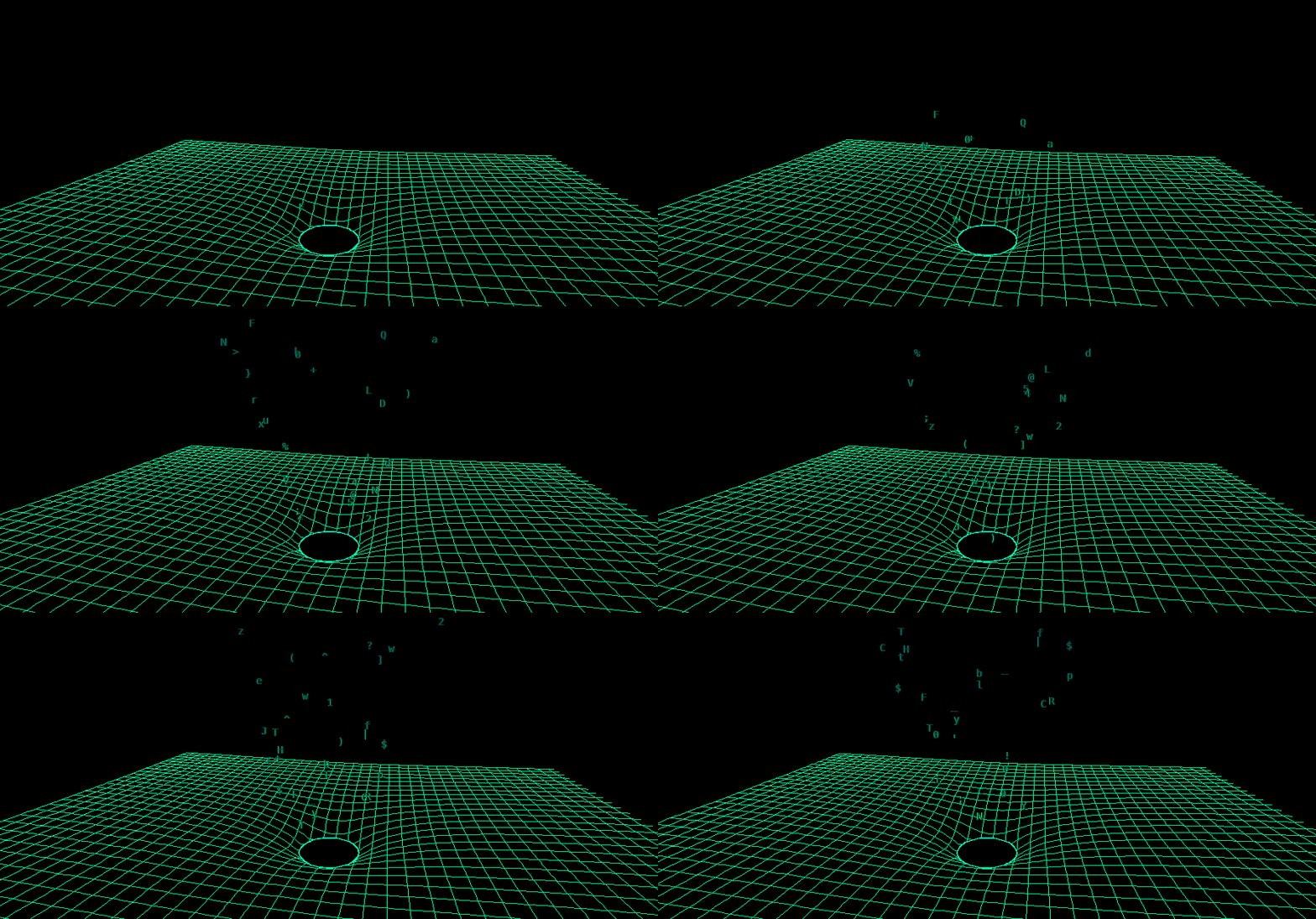
Quantum theory suggests it cannot. Many physicists now believe that black holes do not destroy information but scramble it beyond recognition. The data is not erased — it is redistributed in extraordinarily complex ways.
Within the Matrix metaphor, this is like taking a clear message and transforming it into a dense stream of symbols. The information remains present, but its original structure becomes nearly impossible to reconstruct.
Humans Already Touch the Code
The idea of manipulating hidden layers might sound like science fiction, yet humanity already interacts with fields every day. Radios shape electromagnetic waves. Lasers control photons with remarkable precision. MRI scanners influence quantum properties of atoms. Particle accelerators excite fields directly, revealing new particles as fleeting ripples.
We do not describe this as bending reality. We call it technology. Each generation learns a little more about the underlying structure of nature and uses that knowledge to reshape the world around us. Understanding deeper layers does not mean breaking the rules. It means learning how to work with them.
Is Spacetime Itself Emergent?
Einstein showed that spacetime bends. Quantum physics shows that fields fluctuate everywhere. Some modern theories suggest that spacetime itself may emerge from deeper relationships — possibly patterns of quantum information or entanglement. If that idea proves correct, the Matrix metaphor becomes even richer. Not only are waves moving across a screen, but the screen itself may arise from the flow.
This possibility sits at the frontier of physics, where researchers attempt to reconcile quantum mechanics with gravity. The final picture remains incomplete, but the trend is clear: each layer we uncover reveals a deeper level of structure beneath it.
A Neo Afterthought
In The Matrix, Neo eventually stops seeing walls and bullets. He sees the code beneath them. That does not mean humans will ever rewrite the laws of physics. But history shows that understanding deeper layers changes what feels possible.
Newton revealed motion. Einstein revealed curved spacetime. Quantum theory revealed fields. Modern physics hints at information and deeper patterns beneath even that. Perhaps the lesson is not that reality is an illusion, but that it is far more layered than our senses suggest.
The deeper physics looks, the less the universe resembles a collection of solid things and the more it resembles an evolving pattern — something closer to a living screensaver than a static machine. And like Neo seeing the flowing symbols for the first time, we may still be only beginning to recognize what we are looking at.